He starts the way he's started it every time now, flat, like reciting a phone number.
"It was a two-pence token. Off-colour, heavier than it should've been. I found it wedged under the claw machine, the one with the pink rabbits nobody ever wins, first week I took the maintenance job at the arcade."
He doesn't look at the woman across the table, the one with the lanyard and the ring binder that says HOUSEHOLD CLAIM — REF 4471. He looks at his own hands instead, at the grease still under two of the nails no matter how he scrubs them.
"I kept it. Thought it was a good luck thing. My nan had one like it, off a machine in Rhyl that doesn't exist any more. Or maybe it was Prestatyn. She used to mix the two up too."
The official writes nothing down yet. She's waiting for the part that matters to her: the roof, the fire, the eleven thousand pounds. He knows this. He gives it to her in the wrong order anyway, because the wrong order is the only order that makes sense to him.
The roof went in the October storm, the one that took the Palmer boy's trampoline clean over two gardens. Colin stood under the hole in the spare room with a bucket and did the sums twice. They came out the same both times. He didn't have it. He had the token in his coat pocket, rubbing warm against his thumb the way it always did, and he said it out loud, to nobody, the way you'd say it to a coin down a wishing well.
"I said, I wish I had the money for the roof."
The cheque came four days later. A misdirected legacy, some second cousin of his mother's he'd met twice, dead eighteen months, the solicitors only just catching up with themselves. Eleven thousand four hundred pounds, near enough exact once the roofer's quote came in.
He doesn't tell the official about the token again after that, not for a while. Instead he tells her about Angela, his wife, thirty-one years married — thirty-two now, if he's counting right, he always loses track after thirty — and how she started answering things he hadn't said. She'd turn from the sink and say sorry, love, say that again, when he'd been sat there in silence the whole time, watching the telly with the sound down because she liked it that way after nine.
The audiologist's waiting room had a fish tank with one fish in it, orange, going round and round the same three ornaments. He remembers that better than the appointment itself. She found nothing wrong with Angela's ears. Not with anyone else's voice. Just his. A soft, specific deafness, like a radio that had lost one station and kept every other one perfectly.
"I didn't understand what it was doing at first," he says. "I thought it was her. Getting older. I only worked it out when I picked the coin up again, out of the coat, to wish for something else — small thing, a parking space, nothing — and she was in the room, and she didn't hear that either. Not the wish. Not anything after."
The official asks if he still has the token, for the file.
He says he threw it in the canal by the retail park in March.
He doesn't tell her that he still stands in the kitchen doorway some evenings, mouth moving, shaping her name the way he used to shape it across a dance floor in 1991, watching his wife stir a pan three feet away, entirely at ease, hearing nothing at all.
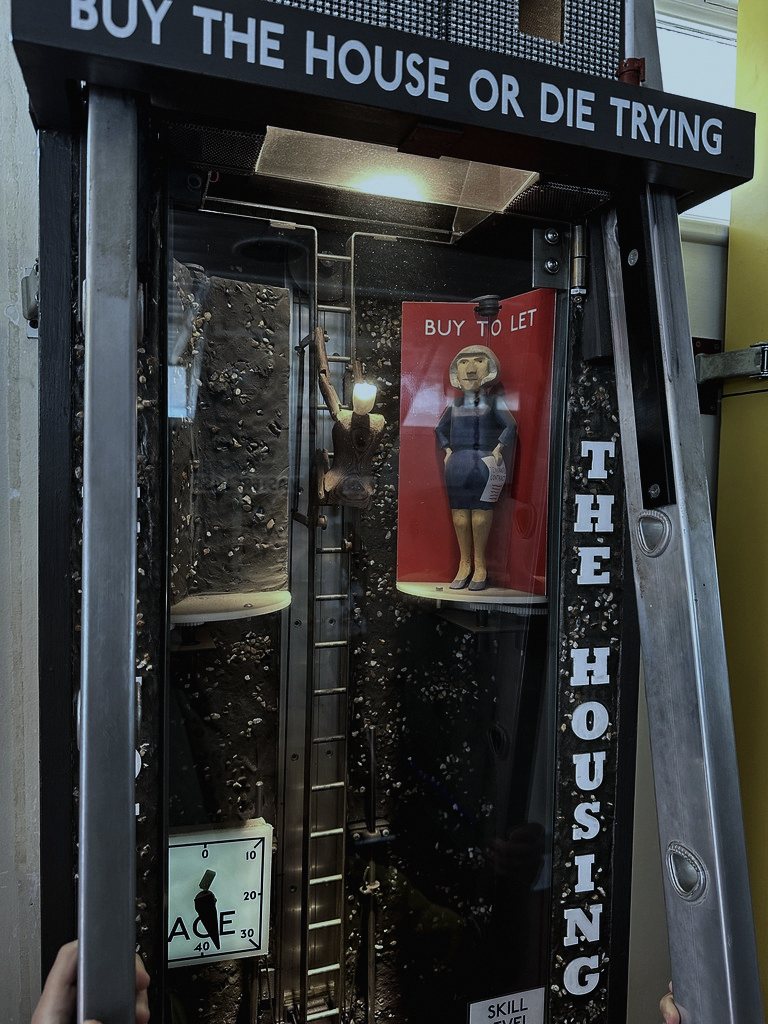
"Buy the House or die trying" by Matt From London is licensed under CC BY 2.0. To view a copy of this license, visit https://creativecommons.org/licenses/by/2.0/.